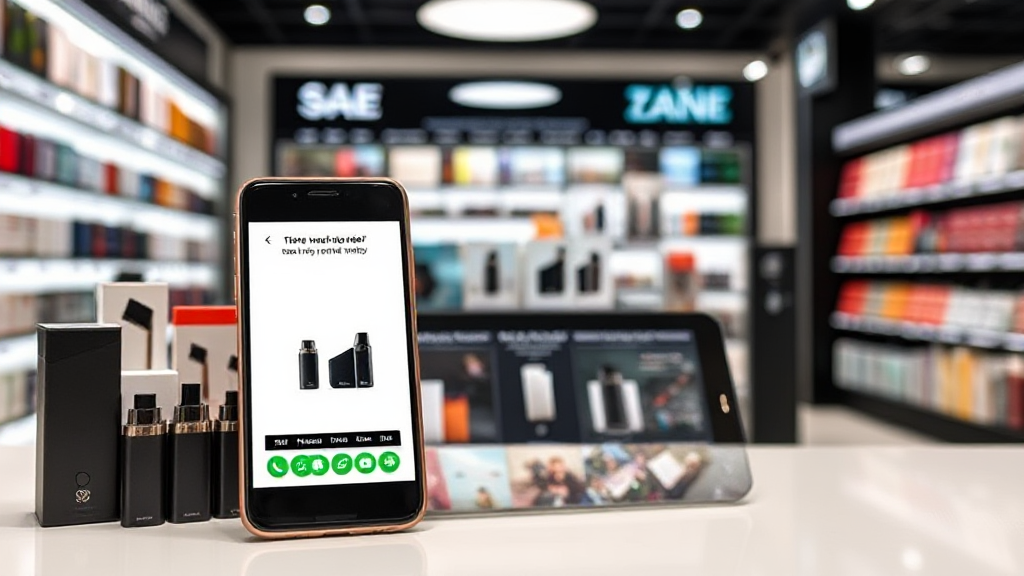
Real Signals and Decorative Ones in Local Vape Storefronts
Most of what you see on a vape storefront is decoration. Bright banners, animated pop-ups, countdown timers, stock photos of unrelated devices, and a wall of trust badges that mean nothing. When I started comparing local sellers for a same-day order, I quickly realised that the useful information is buried under all of it. The trick is not to read more carefully. It is to know which cues actually carry information and which ones are just noise. This is a sceptical shopper’s sort, not a beginner’s tour.
I approached it the way I would approach any delivery purchase in Singapore: I want to know whether the thing I order arrives today, whether it is what it claims to be, and whether the seller is reachable if something goes wrong. Everything else is decoration. The first cue that survived my filter was whether the site actually names its stock and its delivery window instead of gesturing at them vaguely. A shop that says it holds local stock and delivers same day is making a checkable claim. A shop that says “fast delivery islandwide” is making a mood. For context, the clearest example I found of a store that names its claims plainly is lana vape sg, and it is worth using as a reference point for the rest of this comparison.
Claim: A Polished Homepage Means a Reliable Seller
This is the cue people trust most and it predicts the least. A polished homepage tells you someone paid a designer. It does not tell you whether the seller holds stock in Singapore, whether the courier runs on weekends, or whether the product is authentic. Plenty of thin operations have beautiful front pages and no inventory. Plenty of solid ones have plain pages and next-day turnaround.
The counter-signal is boring: look for specificity. A seller who lists actual model names, capacities, and a delivery cutoff time is telling you something about how the business runs. A seller who lists nothing but adjectives is telling you about their marketing budget. When I compared pages, the ones that named real products and real delivery windows were consistently the ones that answered messages. The ones that leaned on slogans went quiet after the first reply.
There is a second layer here. Polished sites often bury the practical details in a footer or a policy page, which is fine, but only if those details are consistent with the homepage claims. If the banner promises same-day and the policy page quietly says two to four working days, the banner is decoration and the policy page is the truth. Read the boring page first.
Claim: Trust Badges and Review Counts Prove Authenticity
Badges are the most decorative element on any storefront. A padlock icon, a “100% authentic” seal, a row of stars — none of these are verifiable from the page itself. Review counts can be seeded. Seals can be copied from another site in an afternoon. I stopped weighting them entirely.
What actually carries information is whether the seller describes how authenticity is maintained: where stock is sourced, how it is stored, whether packaging is sealed and discreet, and whether the product line is consistent from order to order. A store that talks about local stock and sealed, discreet packaging is describing a process. A store that talks about being “trusted” is describing a feeling.
One practical test: check whether the same product appears with the same description across visits. Sellers with real inventory keep stable listings because the stock is real. Sellers drop-shipping from elsewhere often have listings that shift, disappear, or change specs between visits. That instability is a genuine signal, and it is one you can only catch by looking twice.
Claim: Fast Delivery Is Fast Because the Site Says So
Every vape site in Singapore claims speed. Almost none of them define it. The word “fast” is decoration until it is attached to a mechanism. The real signal is whether the seller explains how speed is achieved: local stock held in Singapore, a cutoff time for same-day dispatch, a courier arrangement that runs on the days you actually order. Sg vape shop delivery
This is where the difference between marketing and logistics shows up. A seller who holds stock locally can dispatch the same day because the product is already in the country. A seller who sources from overseas cannot, no matter what the banner says, because the bottleneck is not the courier — it is the supply. So when a page says Lana vape same day delivery, that claim is only credible if the same page also explains that stock is local. The two claims have to match. If they do, the speed is real. If only one appears, treat the other as decoration.
The second half of this cue is the cutoff. A same-day promise without a cutoff time is not a promise, it is a hope. Sellers who run real same-day operations publish a time — order before X and it goes out today. That single number tells you more about the operation than any badge on the page.
Claim: Discreet Packaging Is a Marketing Phrase
Discreet packaging is one of those phrases that sounds like a feature but is often just a word. The decorative version is a bullet point that says “discreet” and nothing else. The real version describes what discretion means in practice: plain outer packaging, no product names on the label, no branding visible to a neighbour or a front desk.
For anyone ordering in Singapore, this matters more than most storefront copy admits. Delivery often goes to a home, an office, or a concierge, and the packaging is the only part of the transaction other people see. A seller who understands this will describe the packaging concretely. A seller who does not will use the word and move on.
The same logic applies to the ordering experience itself. If the checkout is straightforward, the confirmation is clear, and the seller tells you when to expect the courier, that is a process signal. If the site is heavy on urgency pop-ups and light on order confirmation, the discretion claim is probably decorative too. Reliability tends to be consistent across a business, not selective.
Claim: Any Local Shop Is as Good as Any Other
This is the assumption that costs people the most time. Local is not a quality marker by itself. Two sellers can both be based in Singapore and operate completely differently: one holds stock and dispatches same day, the other takes orders and sources later. Both can call themselves local. Only one behaves like it.
The way to separate them is to look for operational detail rather than location claims. Does the seller name the product lines it carries? Does it explain how Singapore vape delivery actually works, including timing and coverage? Does it describe packaging and stock sourcing? Does it respond to a question before you order? These are the cues that survive scrutiny, because they describe behaviour rather than identity.
I found it useful to compare two or three sellers side by side on the same four points: named stock, stated cutoff, described packaging, and responsiveness. The sellers that scored well on all four were the ones I would trust with a time-sensitive order. The ones that scored well on design and poorly on those four were the ones I skipped. That is the whole method, and it works because it ignores almost everything the storefront wants you to look at.
If you want a concrete benchmark, look at how a store handles the practical questions — what is in stock, when it ships, how it arrives, and who answers when something goes wrong. A store that answers those plainly, without dressing them up, is showing you the real signal. A store that answers them with slogans is showing you the decoration.
The verdict is simple. Storefront polish, badges, star ratings, urgency timers, and the word “trusted” are decoration. Named local stock, a published same-day cutoff, concrete packaging descriptions, and a seller who replies are signals. If you sort for the second list and ignore the first, you will pick the right seller in about two minutes — and you will not need to read the rest of the page at all. For a quick reference on what those signals look like when they are done properly, Singapore lana vape is a reasonable starting point, and from there you can judge any Vape delivery sg option on the same four points. The cues do not change. Only the decoration does.



More Stories